Grazeley C of E Primary School

'Be courageous; Be strong; Do everything in love'

SEND

Special educational provision means educational provision that is additional to, or different from, that made generally for others of the same age in a mainstream setting in England.

SEND

Welcome to our SEND Information page. To navigate the page, click through on the yellow headings for more information about each area of SEND at Grazeley.

1. What types of SEND does Grazeley CE Primary School provide for?

SEND stands for Special Educational Needs and Disabilities.

A child or young person has a special educational need if he or she has a learning difficulty or disability which calls for special educational provision to be made for him or her.

A learning difficulty or disability is a significantly greater difficulty in learning than the majority of others the same age.

Special educational provision means educational provision that is additional to, or different from, that made generally for others of the same age in a mainstream setting in England.

Further information can be found in the ‘Code of Practice 2015’  https://www.gov.uk/government/publications/send-code-of-practice-0-to-25

Children and young people’s SEND are generally thought of in the following four broad areas of need and support, as defined in the SEN Code of Practice 2015: At Grazeley CE Primary School we provide for pupils within each of these categories. Click on each heading for more detail about this type of need.

Children with these needs have difficulty with speaking, understanding language, or interacting with others.

They may have:

  • Difficulty understanding what others say (receptive language)
  • Difficulty expressing themselves clearly (expressive language)
  • Challenges with social interaction, such as making friends or interpreting social cues
  • Problems using language for communication in different situations

These needs relate to how a child learns, thinks, understands, and processes information.

Children and young people these needs may:

  • Learn at a slower pace than their peers
  • Have difficulty with understanding new concepts
  • Struggle with memory, organisation, or problem-solving

Find it hard to develop basic skills such as reading, writing, or maths

These needs relate to how a child manages emotions, builds relationships, and behaves in different situations.

  • Children with these needs may:
  • Have difficulty managing their emotions
  • Struggle with forming and maintaining relationships
  • Display challenging or withdrawn behaviour
  • Experience anxiety, low mood, or other mental health difficulties

These needs relate to a child’s physical functioning or sensory processing, which can affect their ability to access learning and the school environment.

They may:

  • Have a physical disability that affects movement or coordination
  • Experience difficulties with hearing or vision
  • Be sensitive to or struggle to process sensory information (e.g. noise, light, touch)
  • Need support to access classroom activities or the school environment

18.32% of the school population are recorded on the SEN Register.

Nationally 19.5%

14.85% school population are recorded as having SEN Support.

Nationally 14.2%

3.47% of the school population are recorded as having an EHCP.

Nationally 5.3%

Miss Julie Easton is our Inclusion Leader and SENDCO. She is responsible for SEND across the school.

Miss Easton is contactable via the school office or by email: inclusion@grazeley.wokingham.sch.uk

I think my child may need SEND Support. What do I do?

Click on each heading for more detail about this type of need.

2. What should I do if I think my child has SEND needs?

We have a collaborative approach to identifying the needs of children. We understand that, as parents, you are the experts in your children. It is important that you communicate any concerns relating to potential SEN in the following ways:


If you think your child might have SEN, the first person you should tell is your child’s teacher.

You can get in touch with the teacher by email, telephone or in person at any point.

You can also contact the Inclusion Leader directly.

We will meet with you to discuss your concerns and try to get a better understanding of what your child’s strengths and difficulties are.

Together we will decide what outcomes to seek for your child and agree on next steps.

We will make a note of what’s been discussed and add this to your child’s record. You will also be given a copy of this.

If we decide that your child needs SEND support, we will formally notify you in writing and your child will be added to the school’s SEND register. 

They will then have Individual Progress Plan detailing the desired outcomes and provision.

3. How will the school know if my child needs SEND support?

In addition to discussions with you and the school staff working with your child, we will use the information outlined below to help us identify what additional support they may need. 

Based on this information, the Inclusion Lead will decide whether your child needs SEND support and discuss this with you. If their needs meet any of the following criteria, your child’s name may be placed on the SEND Register.

  1. Your child is working significantly below age related expectations and is not making progress despite targeted interventions being implemented and reviewed.
  2. Advice has been sought and implemented from an outside agency and an individualised plan has been provided for the school to follow which is over and above the universal provision provided by the school.
  3. Your child has diagnosis (with supporting evidence from an outside professional) which is impacting their learning and development, and whose needs cannot be met from the universal provision provided by the school.

The SEND register has two stages, as outlined below.

  1. SEN Support (K Code):  SEN Support is put in place by the school and follows a cycle called Assess, Plan, Do, Review, where staff regularly check progress and adjust support. The class teacher takes lead responsibility for co-ordinating the child’s special educational provision, working with the Inclusion Lead to produce and implement Individual Progress Plans. School is supported by external specialists to identify and meet the additional needs that have been identified.
  2. EHCP (E Code):  EHCP support is where significant additional support is needed for your child. At this stage we place a request to the Local Authority SEND panel for a Multi Professional Assessment to take place which may result in an Education, Health and Care plan being awarded. If the LA agrees to an Education Health and Care Plan, it arranges, monitors and reviews the provision annually.

Reasonable Adjustments

If your child has medical needs or a diagnosis requiring reasonable adjustments but they can access the curriculum and make academic progress in line with their peers, we will write a support/care plan outlining the adjustments that are in place for them. We work with parents, and where appropriate health professionals, to write these plans. They are reviewed annually or at a point of change in the child’s situation.

4. How will I be involved in decisions made about my child’s education?

We know that you’re the expert when it comes to your child’s needs and aspirations. You will be fully involved in decisions about your child’s education through regular communication, meetings, and reviews where your views are listened to and valued. In line with the SEND Code of Practice (2015) we include parents as equal partners in all SEND planning and decision-making, ensuring your knowledge of your child informs support and provision. The table below outlines the main ways we consult with you.

Action / Event

Who’s involved?

Frequency

‘Open door’ (parents are welcome to arrange a telephone, virtual or in-person appointment)

Class teacher in the first instance.

As and when required by appointment, during term time.

Class teachers are always happy to arrange meetings to discuss progress at a mutually convenient time.

Parents’ Consultation meeting

Class teacher, parent

Termly

Individual Progress Plan (IPP)

Class teacher, parent and young person.

Termly

Inclusion Leader Consultation meeting

SENDCo, class teacher, parent, young person (if appropriate) and other relevant professionals.

As and when required, by appointment during term time.

The Inclusion Leader is always happy to arrange meetings to discuss progress at a mutually convenient time.

EHCP reviews

SENDCo, class teacher, parent and young person and other relevant professionals.

Annually

Reports

Class teacher, young person, Head-teacher.

Annually


5. How will my child be involved in decisions made about their education?

We recognise that pupil voice is important and we aim to include children in the process whenever possible.

The level of involvement will depend on your child’s age, maturity and level of competence. We recognise that no two children are the same, so we will decide on a case-by-case basis, with your input what level of input from them is appropriate.

We may seek your child’s views by asking them to:

  • Attend meetings to discuss their progress and outcomes
  • Prepare a powerpoint, video, drawing, etc.
  • Discuss their views with a member of staff who can act as a representative during the meeting
  • Complete a survey

6. What support is available for me and my family?

Support available for families is outlined on your Local Authority’s web page in their local offer. Each LA’s Local Offer is different. To see what support is available to you in the Local Authority you live in, follow the links below:

Each Local Authority has its own Special Educational Needs and Disabilities Information Advice and Support Service (SENDIASS) whose role is to support parents of children with SEND in their local authority. To see what support is available to you in the Local Authority you live in, follow the links below.

Some local charities that offer information and support to families of children with SEND are listed below:

Some national charities that offer information and support to families of children with SEND are listed below:


My child has SEND Support. What does the school do?

Click on each heading for more detail about this type of need.

7. Which staff will support my child, and what training have they had?

Inclusion Lead & SENDCo

The SENDCO is responsible for implementing the school’s SEND procedures on a day-to-day basis and for co-ordinating provision for all pupils with SEND. Two days a week are allocated to this role.

Julie Easton is our Inclusion Lead and SENDCO. She is a qualified teacher who has worked as a classroom teacher for over 30 years and has experience of working with children with a wide variety of Special Educational Needs. She has just completed the SENDCo National Professional Qualification (NPQSENDCO) and is non-class based.

To arrange to speak with Miss Easton you can:

– Catch her in the playground before school

– Email the school office on admin@grazeley.wokingham.sch.uk

– Email her directly on inclusion@grazeley.wokingham.sch.uk

Class Teachers

Your child’s class teacher has responsibility for ensuring progress for your child, and is your first point of contact. They are supported by the SENDCO to meet the needs of pupils who have SEN or disability. 

Teaching and Learning

All our teachers are teachers of SEND and are trained in adaptive teaching and identification of SEND needs.

Day-to-day teaching includes all the support that is outlined in the Wokingham Borough Council Ordinarily Available Provision document which can be accessed via the following link: Ordinarily Available Provision.

Qualifications and Training

All of our teachers have Qualified Teacher Status and receive in-house SEND training. Some have had more specialised training in different areas of SEND.

Recent staff external training has focussed on supporting children with neurodiversity in schools through the PINS project PINS | SEND Voices Wokingham, and developing staff skills in supporting children with Speech and Language needs through The Grove Speech and Language Unit outreach teacher. The Grove Outreach – Highwood Primary School

Teaching Assistants (TAs) and Higher Level Teaching Assistants (HLTAs)

Your child may also receive support from one of our Teaching Assistants. Our Teaching assistants support children’s learning by working alongside teachers to provide guidance, reinforce lessons, and give additional help to pupils who need it. They also implement targeted interventions.

Teaching and Learning

We have an experienced team of TAs, including 3 higher-level teaching assistants (HLTAs) who support children in class as well as delivering specific SEND Support.

All staff are trained to deliver SEND provision and interventions such as RWI tutoring, Fresh Start and Precision teaching as well as nurture support.

Qualifications and Training

Within our team we have TAs who have completed training for specific interventions in a variety of areas. These include:

RWI phonics group teaching and interventions, Lego therapy, Speech and Language support, Bucket Time, Curiosity Box, Dyslexia Support, Precision Teaching, Friendship Skills, Reading Support, Emotion Coaching, Sensory Circuits, Fine Motor Skills, Colourful Semantics. They are regularly offered, and take, new training opportunities.

Specialised Support

We have members of staff who may offer more specialised support to your child. Their roles and training are outlined below.

Family Support Adviser:  Our Family Support Worker helps children manage their emotions and wellbeing by providing targeted emotional support and guidance. She has had ELSA training.

Donna Crowley is our Family Support Advisor

Nurture Assistant

Our nurture assistant supports children’s emotional wellbeing and social skills. She has completed Wokingham Borough Council’s nurture assistant training.

Jo Greenwell is our Nurture Assistant

Neurodiversity Trained Teacher

Our neurodiversity lead works with the SENDCo to promote understanding and inclusive support for individuals with diverse neurological profiles across the school. She has had training as part of the Wokingham Borough PINS project.

Racheal Hannington is our PINS project Neurodiversity trained teacher.

HLTA with Speech and Language Specialism

Our HLTA with SALT training supports delivers targeted interventions to help pupils improve their communication skills. She has had NHS CYPIT training in SALT.

Mrs Sam Steer is our HLTA with SALT specialism

Headteacher

The Headteacher is responsible for developing and monitoring procedures, implementing and managing the school’s SEND policy, as well as offering advice to the governing board.

Jane Critchlow is our Headteacher and can be contacted via email at admin@grazeley.wokingham.sch.uk

SEND Governor

The SEND governor is responsible for overseeing how a school supports pupils with special educational needs and disabilities, ensuring appropriate provision, inclusion, and compliance with legal requirements.

Naureen Hussain is our SEND governor and can be contacted via email at clerk@grazeley.wokingham.sch.uk

8. How will the school resources be secured for my child?

External Agencies

It may be that your child’s needs mean we need to secure:

  • Extra equipment or facilities
  • Further training for our staff
  • External specialist expertise
  • Additional Teaching Assistant Support

If that’s the case, we will initially consult with external agencies to get recommendations on what will best help your child access their learning and apply these recommendations in school. External agencies consulted may include:

Speech and language therapists (SALT)

Educational psychologists (EP)

Occupational therapists (OT)

Medical Professionals such as GPs or paediatricians

Addington Outreach and Inclusion Service (AOIS)

Social services and other LA-provided support services

Education welfare officers (EWO)

The School nursing team

Local Charities eg: Swings and Smiles

Child and adolescent mental health services (CAMHS)

Wokingham Young Carers

The Grove Speech and Language Outreach Service

A full directory of services that we may call on for support can be found in the WBC’s Ordinarily Available Provision document. Ordinarily Available Provision – Directory of Services

Funding

The school will cover up to £6,000 of any necessary costs. If funding is needed beyond this, with your agreement,  we will need to seek it from our local authority as part of an Education Health Care needs assessment.

9. How will the school adapt its teaching for my child?

There are three levels of SEND adapted teaching in school referred to as ‘Waves of Intervention’
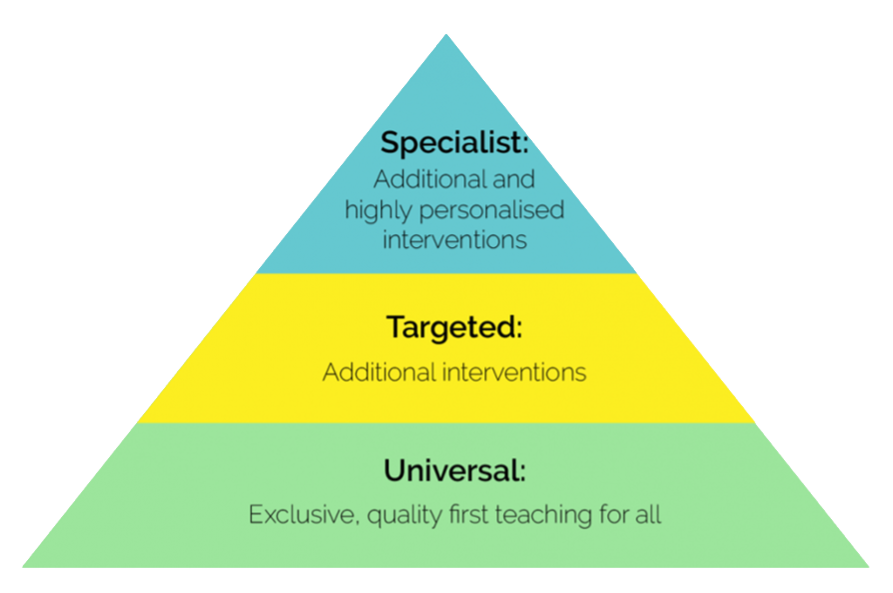
Universal Provision:

Exclusive, quality first teaching for all is our first step in responding to your child’s needs and is available to all children in the class. We adapt how we teach to suit the way the pupil works best. There is no ‘one size fits all’ approach to adapting the curriculum, we work on a case-by case basis to make sure the adaptations we make are meaningful to your child. 

We aim to have this as standard practice in our classrooms. This includes, but is not limited to:

  • Inclusive seating plan (mixed attainment groupings)
  • Ensuring opportunities for movement breaks within lessons
  • Adapting resources such as staffing, scaffolds, concrete materials, technology or dual coded resources, general strategies for visual or hearing impairments,
  • Adapting our teaching, for example, giving longer processing times, pre-teaching of key vocabulary, reading instructions aloud, chunking instructions into smaller steps, modelling vocabulary and social skills, general etc.
  • Using recommended aids, such as laptops, visual aids, larger font, etc. reducing visual stress
  • In some cases, adapting our curriculum to make sure all pupils can access it, for example, by grouping, 1-to-1 work, adapting the teaching style or content of the lesson, etc.
  • Teaching around friendships, social situations and mental health through PSHE

Targeted Provision:

This support is provided for children working below age group expectations or those who have made slow progress over a sustained period of time. They may also present with difficulties in other areas of their school life, such as social skills.

This support may include interventions, some of which take place in the classroom, others take place out of the classroom in small groups or 1:1. Current interventions being used for targeted provision by area of need are:

Area Of Need 

Targeted Provision

Area Of Need 

Targeted Provision

Communication and interaction

Social stories

20-20 club

Role Play

Lego Play

Bucket Time

Cognition and learning

RWInc Phonics Interventions

Freshstart Phonics

Precision Teaching

Guided Reading Groups

Maths Pre-Teaching Groups

Small Group Teaching

Social, emotional and mental health 


Sensory circuits,

Bucket Time,

Pepsi Club (CBT based programme)

20-20 Club

Calm Club

Nurture support

Sensory and/or physical 

Sensory circuits

Write from the Start

Touch typing

These interventions are part of Wokingham’s local offer which can be found here: SEND Local Offer

Specialist Provision:

Some children require a greater level of support which is personalised to their particular need. Where this is the case we will seek advice from external agencies. Where a child has received advice from an external service, they will be included on our SEN Register at SEN Support level. Any child with an EHCP will be receiving specialist provision.

Current Interventions being used for specialist provision include but are not limited to:

  • Following Speech and Language Therapy plans (SALT)
  • Following Occupational Therapy plans (OT)
  • Learning Support Service Recommendations eg. Toe-by-Toe
  • Curiosity Box
  • 1:1 support in class

My child receives SEND Support. How will we know how it is going?

10. How will the school measure my child’s progress?

The Graduated Approach

Underpinning ALL our provision in school is the graduated approach cycle of: Assess, Plan, Do, Review (APDR).
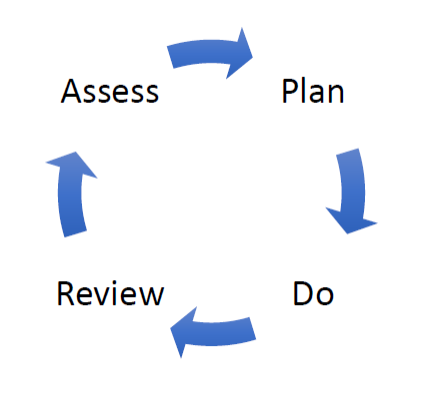
Assess:

We identify areas of strength and where improvement is needed using teacher’s ongoing assessment and through review of your child’s progress towards their outcomes each term in our pupil progress meetings between the headteacher, SENDCo and class teacher. We may also use additional in-school assessments or assessments from other relevant professionals such as Speech and Language therapists or Educational Psychologists to gain greater insight into their barriers to learning.

Plan:

We use information gained from the assessments to plan approaches to support your child. Where external advice has been sought, an Individual Progress Plan (IPP) is developed by the Class Teacher and SENDCO in collaboration with you and any other relevant professionals. We will keep a record of this, and you will receive a copy.

Do:

We implement the support. All involved parties will actively participate in the delivery of any additional provision required. The class teacher, with the support of the SENDCo, will be responsible for the progress of your child towards their outcomes.

Review:

We will continually review your child’s progress towards their targets. Their Class teacher will review the IPP termly to see if the provision is enabling your child to make the planned progress. We will then use our improved understanding of your child’s needs to improve or adapt the support we offer. We use the following code to review the outcomes on the child’s Support and Achievement Plan. This helps us understand what provisions have been successful or not.

Scale​

Level of outcome​

+2​

Much more than expected​

+1​

More than expected​

0​

Expected​

-1​

Less than expected ​

-2​

Much less than expected​

This APDR process will be continual. If the review shows your child has made progress, they may no longer need the additional provision made through SEND support. If not, the cycle will continue, and the targets, strategies and provisions will be revisited and refined.

11. How will the school evaluate whether the support in place is helping my child?

We evaluate the effectiveness of provision for your child by:

  • Reviewing the impact of interventions after 6 weeks
  • Using pupil questionnaires
  • Monitoring implementation by the SENDCO
  • Discussing pupil progress with the senior leadership team each term
  • Holding an annual review (if they have an education, health and care (EHC) plan).

My child’s situation is changing. How will the school support?

My child is making good progress and is accessing learning alongside their peers.

In discussion with you, your child’s class teacher and the SENDCO, your child’s name will be removed from the SEND register when they have progressed in-line with age-appropriate expectations and maintained the level of attainment appropriate for their age for at least one term.

Your child’s progress will continue to be closely monitored by their class teacher to ensure they continue to make acceptable progress.

If this progress changes, they can be re-added to the SEND Register at any time and a new IPP written and implemented.

My child is struggling to learn in spite of additional support.

In discussion with you, your child’s class teacher and the SENDCO, we will review the level of support that your child is receiving. We may decide to seek advice from different external professionals as we continue to identify their barriers to learning.

It may be that we need to consider applying for an EHCP with specific funding to provide greater levels of support to enable your child to make progress within a mainstream setting.

It may be that a mainstream setting is no longer able to meet your child’s needs and we will address this through the EHCP cycle of review.

12. What support will be available for my child as they transition between classes or settings or in preparing for adulthood?

Transition into school at Foundation Stage

We will support your child coming into school through the following:

  • A parent information meeting for you
  • A social story leaflet about the classroom for your child
  • A stay and play session for you and your child
  • A PTA organised Teddy Bears Picnic for you and your child
  • A morning familiarisation session for your child on their own
  • A half day visit in September in a small group of ten children.
  • A visit to your child’s pre-school setting and talk with their key worker
  • A home visit for you and your child in September.
  • A Year 6 buddy who supports your child in their transition into school.
  • For children with SEND – a meeting with the school SENDCO prior to starting school. Contact with medical professionals will be made where appropriate.

For children with SEND or who are very anxious – additional visits after school where a child to become familiar with the classroom when it is less busy


Transition between Year Groups

We will support your child as they move through the different year groups in school in the following ways:

  • Your child’s IPP is updated in the Summer Term by their current class teacher and details shared in discussion with their next teacher.
  • Any current reports by external professionals are shared with the new class teacher
  • The SENDCO and new class teacher talk through the IPP in September to ensure all provision is in place.
  • We schedule informal additional transition opportunities for children with SEND to see their new classroom and class teacher eg. Being asked to take messages or collect equipment
  • Additional story times in their current room with their new teacher
  • Formal transition (move-up) day where the child spends time in their new classroom with their new class teacher.
  • Leaflets including classroom, teacher etc. are shared with all families for children to view over the summer holidays.
  • Meetings between parents fo children with SEND and their new class teacher in September
  • ‘Meet the teacher’ parent information sessions at the start of each year
 
Transition to Secondary School

We will support your child to move into Secondary education in the following ways:

  • Supporting them to be organised and to become independent. 
  • Our SENDCO and the SENDCO at the receiving secondary school will discuss the needs of all the children who are receiving SEND support.
  • We will recommend children who would benefit from additional transition visits. These are offered at the discretion of the secondary school.
  • Parents of children with SEND are encouraged to take their children to Secondary school open days to familiarise them with the school and to attend any information sessions for parents of children moving to the school who have SEND.
  • Where a child has an EHCP their transition into secondary education will form part of their Year 5 Annual Review.
  • Where the secondary school placement has been confirmed, the receiving school’s SENDCO will be invited to attend their final Year 6 Annual Review at Grazeley.

Transition between Schools at any other time

Moving into Grazeley

If your child has identified SEND needs and moves into Grazeley school during their Primary phase of education, the SENDCO will meet with you to discuss your child’s needs and how they are best supported.

The SENDCO will make contact with your child’s previous setting to gain a full understanding of how best to meet their needs.

You and your child, as well as any siblings,  will be invited into school when it is quiet – usually after school – to look round and become familiar with the setting.

You will be emailed the transition leaflet for the class that your child is moving into.

Leaving Grazeley

If your child has identified SEND needs and leaves Grazeley school during their Primary phase of education, our SENDCO will contact the SENDCO at the receiving primary school to discuss your child’s needs and the support that is currently in place for them.

We will share your child’s SEND information and records with the new school.

Additional Information

Equity and Inclusion

13. How will the school make sure my child is included in activities alongside pupils who don’t have SEND?

At Grazeley school, we are committed to ensuring your child is fully included in all aspects of school life. We recognise that every child has unique needs, and we take a personalised approach to support your child to learn, participate, and thrive alongside their peers. Following the in line with the SEND Code of Practice (2015), we aim to remove barriers to learning and participation so that your child can enjoy a fully inclusive school experience and achieve their best outcomes.

Your child:

  • Will be encouraged to join in with extracurricular activities, including clubs, trips, and events, with appropriate adjustments in place.
  • Their individual needs are considered when planning activities, ensuring they can participate alongside their peers.
  • May use specialised equipment or resources to help them access learning and wider school experiences.
  • Will be included in group work and collaborative tasks, with support to build confidence and social skills.
  • Their voice is listened to, and their preferences are taken into account when planning support and activities.
  • Benefits from tailored strategies to help them feel safe, supported, and included in the school environment.
  • Is given opportunities to take part in assemblies, performances, and celebrations, with reasonable adjustments where necessary.
  • Is supported during transitions and less structured times (such as break or lunchtime) to ensure full inclusion.

14. How does the school make sure the admissions process is fair for pupils with SEN or a disability?

Grazeley School welcomes all children, including those with special educational needs and disabilities (SEND), in line with the school’s

Admissions Policy

Admissions are managed through the Local Authority. Parents of children with SEND can contact the SENDCo to discuss their child’s needs and arrange a visit. Children with an Education Health and Care Plan (EHCP) will be admitted if the Local Authority names Grazeley School as the most appropriate placement.

15. How does the school support pupils with disabilities?

We have an accessibility plan that is regularly reviewed to ensure all pupils with disabilities can fully access the education, opportunities, facilities and services we provide, with appropriate support in place. Guidance from relevant medical professionals is sought and followed when needed.

16. How will the school support my child’s mental health and emotional and social development?

We support pupils’ emotional and social development by providing a range of opportunities to build confidence, manage feelings and develop positive relationships in a safe and supportive environment.

  • Pupils with SEND can attend quiet lunch club if the hall is overwhelming at lunchtime.
  • Indoor club  is available daily to help children manage friendships and social time.
  • One-to-one pastoral support is available with our ELSA trained Family Support Worker, Mrs Donna Crowley.
  • Our trained nurture assistant, Jo Greenwell, runs Calm Club at the end of the day to help pupils with SEND process the day’s events.
  • We offer ‘Pepsi Club’ (a short CBT-based programme) to support children with anxiety.
  • Sensory circuits run each morning to help pupils regulate their emotions before learning.
  • Lego Play sessions support social and emotional development.
  • Role play, social stories and small friendship groups are used to support specific social needs.

We have a zero-tolerance approach to bullying (see Anti-Bullying Policy).

17. What support is in place for looked-after and previously looked-after children with SEND?

Mrs Jane Critchlow, the Headteacher, is the designated teacher for looked-after and previously looked-after children at Grazeley. She works closely with the SENDCo, to ensure that staff understand how a pupil’s care circumstances and special educational needs may affect their learning. Looked-after and previously looked-after pupils are supported in the same way as other children with SEND, and they also have a Personal Education Plan (PEP). We ensure that PEPs and any SEND or EHC plans work together to provide consistent and effective support.

18. What should I do if I have a complaint about my child’s SEND support?

Complaints about SEND provision in our school should be made to the SENDCO in the first instance. They will then be referred to the school’s complaints policy. If you are not satisfied with the school’s response, you can escalate the complaint. In some circumstances, this right also applies to the pupil themselves. To see a full explanation of suitable avenues for complaint, see pages 246 and 247 of the SEN Code of Practice. 

If you feel that our school discriminated against your child because of their SEND, you have the right to make a discrimination claim to the first-tier SEND tribunal. To find out how to make such a claim, you should visit: https://www.gov.uk/complain-about-school/disability-discrimination

You can make a claim about alleged discrimination regarding:

  • Admission
  • Exclusion
  • Provision of education and associated services
  • Making reasonable adjustments, including the provision of auxiliary aids and services

Before going to a SEND tribunal, you can go through processes called disagreement resolution or mediation (see Global Mediation), where you try to resolve your disagreement before it reaches the tribunal.

Glossary of Terms

19. Glossary

  • Access arrangements – special arrangements to allow pupils with SEND to access assessments or exams
  • Annual review – an annual meeting to review the provision in a pupil’s EHC plan
  • Area of need – the 4 areas of need describe different types of needs a pupil with SEND can have. The 4 areas are communication and interaction; cognition and learning; physical and/or sensory; and social, emotional and mental health needs.
  • CAMHS – child and adolescent mental health services
  • Differentiation – when teachers adapt how they teach in response to a pupil’s needs
  • EHC needs assessment – the needs assessment is the first step on the way to securing an EHC plan. The local authority will do an assessment to decide whether a child needs an EHC plan.
  • EHC plan – an education, health and care plan is a legally-binding document that sets out a child’s needs and the provision that will be put in place to meet their needs.
  • First-tier tribunal/SEND tribunal – a court where you can appeal against the local authority’s decisions about EHC needs assessments or plans and against discrimination by a school or local authority due to SEND
  • Graduated approach – an approach to providing SEN support in which the school provides support in successive cycles of assessing the pupil’s needs, planning the provision, implementing the plan, and reviewing the impact of the action on the pupil
  • Intervention – a short-term, targeted approach to teaching a pupil with a specific outcome in mind 
  • Local offer – information provided by the local authority which explains what services and support are on offer for pupils with SEN in the local area
  • Outcome – target for improvement for pupils with SEND. These targets don’t necessarily have to be related to academic attainment 
  • Reasonable adjustments – changes that the school must make to remove or reduce any disadvantages caused by a child’s disability  
  • SAP – Support and Achievement Plan
  • SENDCO – the special educational needs and disabilities co-ordinator
  • SEN – special educational needs
  • SEND – special educational needs and disabilities
  • SEND Code of Practice – the statutory guidance that schools must follow to support children with SEND
  • SEN information report – a report that schools must publish on their website, that explains how the school supports pupils with SEN
  • SEN support – special educational provision which meets the needs of pupils with SEN
  • Transition – when a pupil moves between years, phases, schools or institutions or life stages